
Belgrade
MILORAD BATA MIHAILOVIĆ’S CENTRAL PERIOD IN PARIS (1962-1975)
Sofija Ž. Mienković
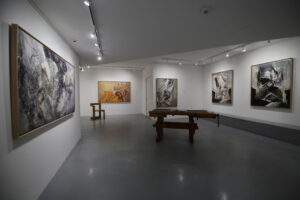
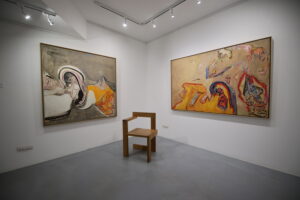
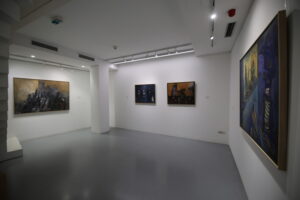
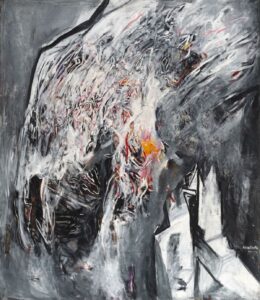
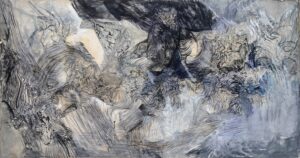
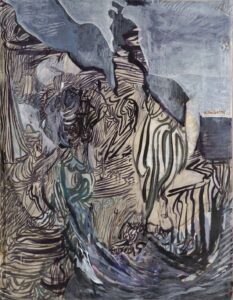
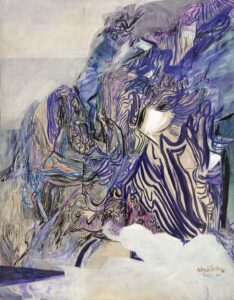
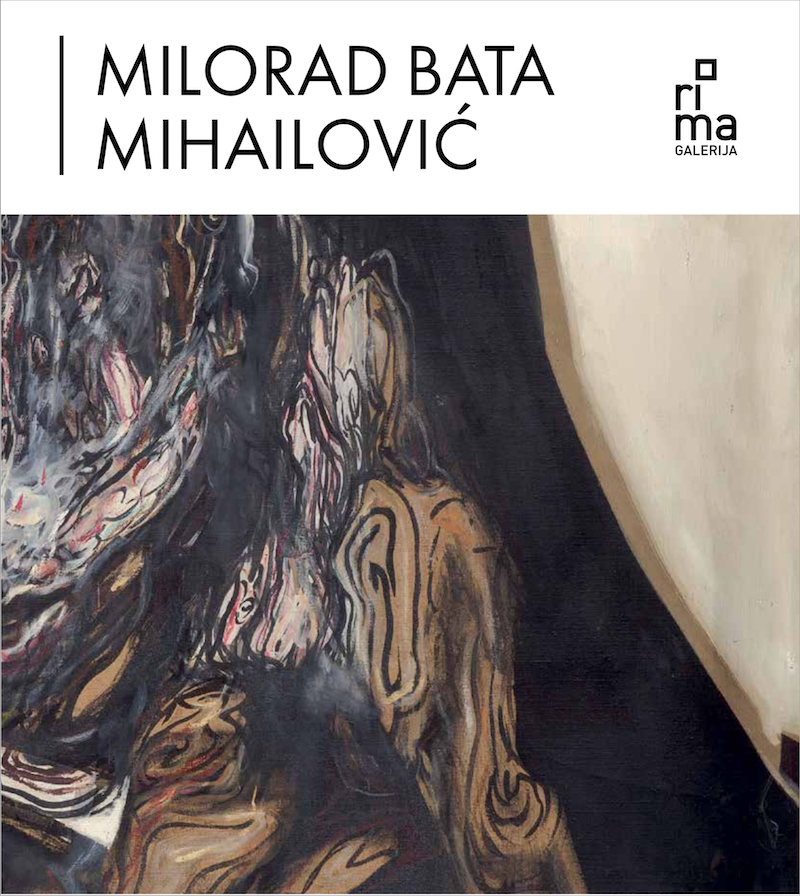
The central Parisian creative period of Milorad Bata Mihailović is marked by the fruition of his authentic visual arts language. Almost a decade after his movement to Paris in 1952, he entered a period of intensive painterly production and regular exhibition activity. In the 1960s and during the first half of the 1970s he had a number of solo and group shows in Paris and other European cities.
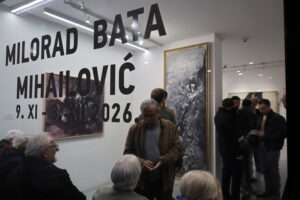
His cooperation with the Gallery Ariel and its owner Jean Pollac, has a special place in his professional affirmation and position in the international setting. This cooperation began with Mihailović’s solo exhibition in 1961 and its continuity was confirmed by a series of future solo shows in this gallery, performed in 1963, 1966, 1970 and 1974, as well as numerous group exhibitions with the artists from Pollac’s circle. At the same time Mihailović exhibited in other European centers as well, such as: The Hague (1962), Brussel (1963), Copenhagen (1964), London (1966), Lille (1967 and 1970), Rome (1968), Oslo (1969 and 1970) and Umea (1975).[1] His return to the local visual arts scene was marked by his second solo exhibition in Belgrade, in 1965 in the Salon of the Modern Gallery. It was the first time that he brought over his abstract works created in Paris.
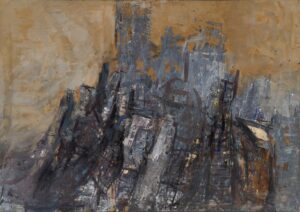
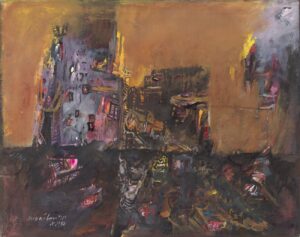
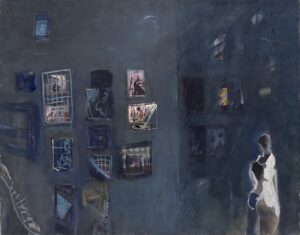
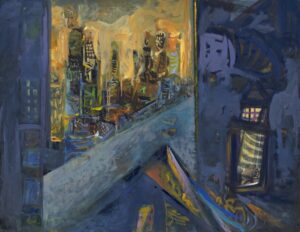
His arrival in Paris offered Milorad Bata Mihailović an opportunity to meet diverse forms of post-war abstraction, unknown to him until then – from the traditional „cold“ geometry and different individual approaches to lyrical abstraction, to Tachisme and Informel. He appropriated the formal language of abstraction gradually, first through gentle geometrized forms, starting with urban landscapes he had particularly liked even during the Belgrade figurative period, fashioned within the Zadar Group.[2] In that transitory period he painted the first „imaginary landscapes“ and “non-existent villages“. In the second half of the 1950s the form gradually dissolved into a freer, more expressive handwriting, and the artist became in full command of the autonomous world of the painting. This process culminates in the works on paper titled Compositions, created in 1958–1959, in which references to recognizable objects recede in favour of the autonomy of the picture plane, colour and line, while the title emphasizes the primacy of internal pictorial organization.[3] However, distancing from the recognizable motif did not mean his break with visible reality which would remain the permanent source of his creative production: „I have never separated from the first taste of the figurative that I had brought from here to Paris, not have I ever lost the need to use the surrounding world as the basic nourishment.“[4]
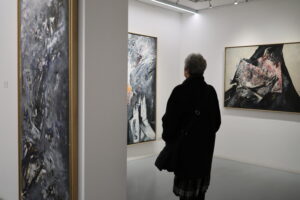
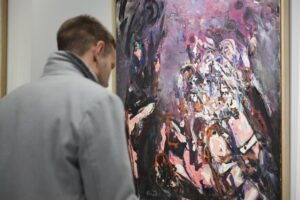
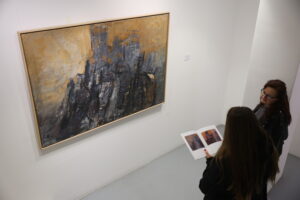
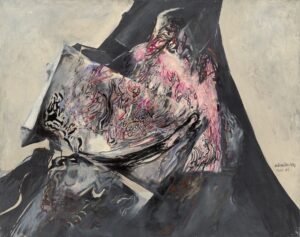
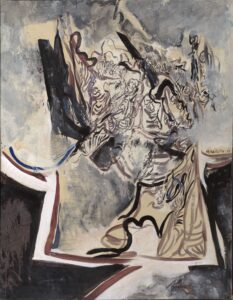
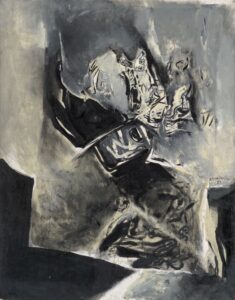
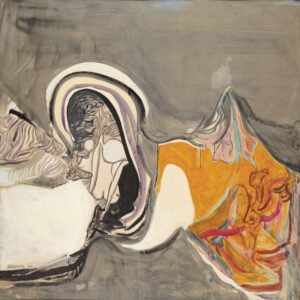
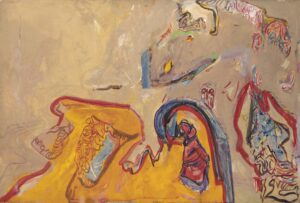
That „taste of the figurative“ in seemingly totally abstract compositions unequivocally links Mihailović’s painting with the tendencies of the second wave of lyrical abstraction, where nature became again an important source. French art historian Michel Ragon characterized such approaches with the notion of „abstract landscape“, defining painting that „addressed nature without describing it“,[5], where the impressions instigated by the phenomena or objects from nature are transposed into the formal language of abstraction. Instead of transferring the recognizable contours of the landscape, Mihailović separates its dynamic and atmospheric qualities and creates a painterly space that simultaneously summons natural phenomena and keeps autonomous abstract compositions. On the occasion of Mihailović’s solo show in the Gallery Ariel in 1963, Georges Boudaille noticed that there were sometimes „in his paintings, interesting visual mechanisms and forms that imagination wishes to identify differently… as landscapes (sic), bushes, cliffs, fiords“, but that those forms were born on the other side of the abstract and not by means of returning to previous aesthetic phenomena“.[6]
(…)
______________________
[1] At the exhibition at Gallery RIMA in Belgrade (2026), when this catalogue was published, Mihailović’s works from 1962 to 1975 are shown. Therefore, the list of international exhibitions contains only those relevant to this period. More details with: Ješa Denegri, Lidija Merenik, Marija S. Đorđević, Milorad Bata Mihailović, Kragujevac: Galerija RIMA, 2023.
[2] The Zadar Group were: Miodrag Mića Popović, Petar Omčikus, Kosara Bokšan, Milorad Bata Mihailović, Ljubinka Jovanović, Vera Božičković and Mileta Andrejević. They stayed in Zadar between April and August 1947 painting freely, no longer linked to the socialist realism of the then Academy of Fine Arts. Because of this mutinous adventure of the “Zadar communards” the group of students were not allowed to regular studies; However, they were subsequently allowed to return, all of them except Mića Popović. Although they were not a kind of an official artistic movement, they have been remembered as the so called “Zadar group”. In Mihailović’s Belgrade paintings the figure carries major importance, most frequently through the genre of portraits, self-portraits and cityscapes, with paintings of Belgrade as the most impressive (Belgrade with Yellow Sky, 1950, Great Belgrade, 1951).
[3] On the Compositions, see: Marija Stanković (Marija S. Đorđević), “Razmišljanja o likovnim elaboracijama na papiru Milorada Bate Mihailovića” [Reflections on the Artistic Elaborations on Paper by Milorad Bata Mihailović], in Milorad Bata Mihailović, exhibition catalogue, Kragujevac: Galerija RIMA, 2020.
[4] Quoted in: Ješa Denegri, „Pariske godine Milorada Bate Mihailovića“ [The Paris Years of Milorad Bata Mihailović], in: Denegri, Merenik, Đorđević, Milorad Bata Mihailović, 61.
[5] Michel Ragon, „Lirska apstrakcija. Od eksplozije to inflacije” [Lyrical Abstraction: From Explosion to Inflation], in: Oto Bihalji-Merin, Lj. Stefanović (eds.), Posle 45: Umetnost našeg vremena, Ljubljana-Beograd-Zagreb: Mladinska knjiga, 1972, 81-82.
Works


Publications


- More about the artist